Restructure bond, restructure economy

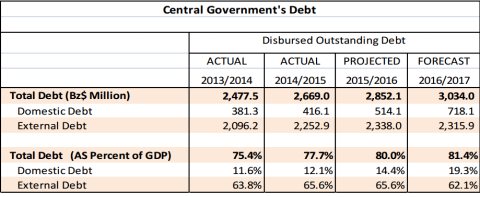
Fundamentally, the Belize US-Dollar Bond 2038 (super bond) needs to be restructured based on several factors. Probably none more clear-cut than the simple reality that global and regional growth are not expected to be as robust as one may hope. But the bond restructuring is only but one part of a much more comprehensive “restructuring” that we need to look at, but we are yet to adequately address the underlining causes as to what brought us to this point.

The origins of the Super Bond could somewhat be well summarised as being a mix of expansionary fiscal policies that rapidly increased the average government deficit from 3% to 9% of GDP within a span of about six year; climbing public debt, much of which was sourced from external sources who, on account of our declining credit ratings, kept increasing the costs at which we borrowed; and widening current account deficits.

As was pointed out in the working paper  “Sovereign Debt Restructurings in Belize: Achievements and Challenges Ahead” by Asonuma et. al (2014):

“At the same time, Belize’s external condition became more challenging owing in part to
high world oil prices, declining export prices, and rising external debt service costs.
Trade imbalances, coupled with surging debt service burden, led to significant current
account deficits, which averaged 17.3 percent of GDP during the period 2001 through 2005.
The large current account deficits were principally financed through a build-up of external public debt, which almost tripled from less than US$400 million in 1998 to US$1.1 billion in 2005.”

Without venturing into any in-depth analysis of the period between 1998 and the first restructuring in 2007, ideally, one key lesson here is the need for our government and people to take care on how we spend and increase our expenditures. That much, one could say, is within our control. And, it’s prudent to do so because we all know that there are factors such as global commodity prices, natural disasters, and even changes in the global and regional economy that are outside our control, to name a few.

A look at the Global and Regional Landscape

Speaking of factors outside of our control, this conversation would be incomplete without at least a brief look at developments in the global and regional economy.

In terms of the entire Latin America and Caribbean (LAC) region, average growth for 2016 and 2017 has been forecast at -0.6% and a meagre 1.6% growth for 2016 and 2017, respectively. The expectation is that the weakened global demand and trade that led to the negative outlook for 2016 would have tapered off by 2017. The International Monetary Fund (IMF), speaking on this point in its October 2016 Regional Economic Outlook Update, elucidated, “Growth is expected to rebound to 1.6 percent in 2017 (0.1 percentage point higher than in the April projections), as global demand gradually picks up and domestic policy uncertainty declines. Medium-term projections continue to be subdued, with the region expected to grow a mere 2.7 percent.” Continue reading

Who Dropped the Ball with NCL?

“I think the tourism representatives may be able to speak directly to that issue. From the very onset of those negotiations, it was clear that the NCL ships will be sent down south that would create some opportunity for the southern region of Belize.As you know that is the most impoverish in terms of opportunities. And so, I am not sure what negotiations FECTAB had, if any, with NCL in terms of being facilitators of tours here in the Belize District. I know that there are a number of tour operators and tour guides in the south who have prepared themselves to benefit from the NCL project in that area. But I don’t have the finer details and I think the tourism representatives can add some more value to that discussion.”–Minister of State Tracy Panton

Based on the level of data made public, I could certainly appreciate why FECTAB members would be alarmed at the “recent” developments as it pertains to Norwegian Cruise Line (NCL)’s Harvest Caye project and the potentially negative impacts it could have on FECTAB members’ revenues.

Nevertheless, this, in my opinion, is what happens when there are a couple of things absent from the public sphere: (a) a large news consumer base that incentivizes the media to keep these types of issues in the fore, (b) limited appreciation of the truly competitive and fluid nature of business, and (c) requisite communication (including listening) skills, preparation and negotiating skills from some key public and private-sector stakeholders.

Why do I say this? Because, I could think back to 2013 when I was still in the media and this issue came up regarding NCL and whether or NOT it would divert ships down south to Harvest Caye. I’m glad that 7News went back to archive footage this week. Because from at least three years ago, one needed to “listen carefully” to what was actually being said.

Continue reading

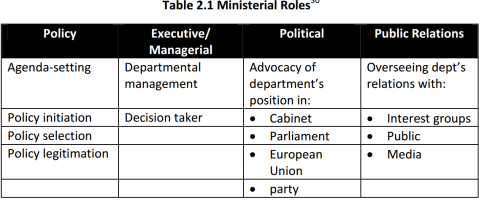
Westminster’s Systemic Catch 22: an executive of ‘GOATS’ vs. Politicians

“For many, ‘representation’ is synonymous with political reward, or patronage. Ministerial posts are also now used as a means of ensuring loyalty, or at least acceptance of the government approach. Prime Ministers wish to appoint those who are loyal: both to the party and to his or her own position as party leader.”–(Young and Hazel, 2011).

In my childhood years I could only recall a maximum of four times when my mother felt it was necessary reprimand me in true Belizean style. One of those times occurred when I was about eight years old, and I decided to jokingly throw politically charged obloquies at our neighbour whose relation to a highly ranked area representative made him a “politically exposed” person (if I may use that term loosely).  Continue reading

The economic outlook and pay raise?

Avoiding any of the politics and emotive elements of this particular issue, in many ways I have to endorse what the Public Service Union and the Association of Public Service Senior Managers (APSSM) have decided to do: that is, defer their pay raise/adjustment given the distressed state of the Belizean economy.
 
Currently, the entire global outlook is less than optimal. One could pick from any reputable source for macroeconomic forecast and the story remains the same: the outlook for Caribbean economies “remains fragile”.
 
For example, the International Monetary Fund (IMF) 2016 Regional Economic Outlook (Western Hemisphere) put it this way: “With the global economy still struggling, many countries in Latin America and the Caribbean are facing a harsher world than they did just a few years ago.” (See IMF report here)
 

Continue reading

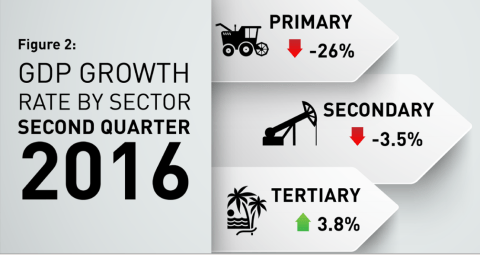
Keeping Hope Alive: Can Belize’s Q3, Q4 growth figures pull us up?

Okay, so there is certainly a lot going on in the Belizean political scene of late. Everything from the Audit Report to the Section 53 ruling to the Mason saga have been dominating the news cycle and public discourse for the last few weeks. However, one line of conversation has quietly slipped into the background: the Belizean economy.

Earlier this year the International Monetary Fund (IMF) had indicated that 2016 would have seen subdued GDP (Gross Domestic Product) growth at about 0.5%; however, it’s likely that even their estimate could prove to be a bit more on the optimistic side of things.  Continue reading

Legality versus Morality: what’s ‘Christianity’s’ role in modern-day democracies?

“But let none of you suffer as a murderer, or as a thief, or as an evildoer, or as a busybody in other men’s matters.”–1 Peter 4:15

“Christians, from mistaken zeal, under the plea of faithfulness, might readily step out of their own calling and make themselves judges of the acts of unbelievers. Literally, ‘a bishop in what is (not his own, but) another’s’ province; an allusion to the existing bishops or overseers of the Church; a self-constituted bishop in others’ concerns”. (See Jamieson-Fausset-Brown Bible Commentary)

 In the wake of the recent Section 53 ruling, many Belizeans who are either devout members of a particular christian denomination or simply disgusted by the homosexual lifestyle have come out swinging at the Chief Justice and  the members of the gay community. Fundamentally, I understand what has some members of the church community so up in arms. They’ve been consistently fed a doctrine that one of their principal missions in life is to speak out against sin, and there’s been some who have been fed from a school of thought that suggests that God is prone to send calamity upon a nation where such sin exists. The latter, of course, stems from Old Testament teachings, with examples such as the destruction of Sodom and Gomorrah reigning as one of the most prominent cases.

Continue reading

Technocrats as Ministers vs. Politicians as Ministers

Since 2014, I had purposed to myself to no longer spend time discussing themes such as “corruption” and “transparency” in government. Fundamentally, I find it to be a virtually pointless exercise. The conversation usually revolves around politicians in office; however, I have long since adopted the views expressed in Hulse, Gordon and Herrera’s “Fixing the System” booklet.

In said publication, written roughly a decade ago and which presents ideas that are by no means “brand new” to the discourse on the need for structural reforms, the authors suggested, among other things, that the members of Cabinet be made up mostly of non-elected officials. Why was such an idea deemed necessary? The fact of the matter is this: while many Belizeans spend much time blaming politicians for the existence of corruption in public affairs, the reality of the matter is that there is a large portion of the electorate who put demands on said politicians to share the “spoils” of their “political victory”.

I will spare you the long drawn out discussion on clientelism and its ills, but shall limit this post to simply say that it is the relationship between the “client” and the “patron” (the voter and political actors) that is the true source of corruption.

Moreover, it would appear that all stakeholders, including the media, have accepted as normal the distribution of ministerial portfolios to area representatives as a type of reward for bringing in the votes. When one looks at the recent conversation regarding former Deputy Prime Minister Gaspar Vega’s removal from the Ministry of Natural Resources, it becomes clear that these portfolios are viewed in this manner. Is that the most efficient approach? The answer, I believe, is self evident.

Therefore, temporarily breaking my two-year moratorium on this topic, it would appear that Prime Minister Barrow does rightly demonstrate more confidence in NON-elected officials’ ability to straighten up ministries, as we all should. His recent Cabinet reshuffle yet again displays this apparent truth, as non-elected Senator Godwin Hulse, one of the authors of the “Fixing the System” publication I alluded to earlier, now becomes the Minister of Police, in the midst of this ongoing “Danny Mason” scandal. Simultaneously, another non-elected figure, Attorney General Vanessa Retreage takes over the Natural Resources portfolio. But, in order for her to take on this post, she must first be sworn in as a senator, thereby, replacing one of the current senators.

The Constitution

Undoubtedly conspicuous is the fact that non-elected officials are not motivated by the same things as their elected counterparts are; moreover, a party leader would be able to fire such non-elected offcials without fearing a weakened position in the Legislature. Therefore, it’s logical to expect “better” performance. However, our constitution [Specifically Section 40(2)] limits any Prime Minister from appointing a minister who is NOT a member of the House of Representatives or the Senate. Therein lies the rub.

The Constitution states: “Appointments to the office of Minister shall be made by the Governor-General, acting in accordance with the advice of the Prime Minister, from among members of the House of Representatives and of the Senate”

It is for this reason that I’ve deemed the current nature of the “corruption” conversation to be relatively futile, because we continue to discuss “personalities” and “individuals” as opposed to the requisite systems overhaul.

Consequently, instead of chasing behind politicians from one corruption scandal after the other, in my view, the conversation in the public sphere may get more long-lasting results by looking at possible amendments to Section 40(2) of the Constitution. However, not too long ago, in the heights of the Penner scandal, it was Senator Hulse who commented to the effect that if the media had given the “Fixing the System” call for reform the same degree of attention they gave “Pennergate”, the issue itself may have never emerged. But reform talk isn’t as entertaining.

But is the media at fault? The media falls victim to the same market forces of any business: they have to “sell” what there’s a demand for. Therein lies another rub and the epitomic definition of a “Catch 22” scenario. I think of Al Jazeera America’s demise here too.

In my view, it’s preferable to have a system in which ALL ministers be technocrats as opposed to politicians, but how do you get the majority of the constituents and the electorate to first become aware, then interested, then to desire, and lastly demand such change. As things currently stand, if the media were to put such things as headline news everyday, it’s likely they’d lose viewers/readers’ interest, which would likely translate into revenue loses for said media houses. Although, some would say it’s just a matter of packaging. I won’t deny that there’s truth to that point, except to say that such “packaging” comes with higher operational costs, at least in the earlier phases.

The Long-term Solution

In the end, to achieve mass “buy in” for such reform, there is need for medium- to long-term social marketing efforts that educate the masses of the superior benefits of having such a change. This is where civil society, for example, can come in. Of course, the media could also help with specific shows, columns, editorials or programs that slowly but surely promulgate these views.

It, however, cannot be overnight. The ugly truth is this: some politicians may actually be voted out of power under a system in which they have no ministerial “power” over the country’s resources. Therefore, Prime Minister Barrow and any other party leader will be careful how they approach any such change. Think about it: what would many voters do if they can’t get that scholarship or that “piece of land” from their area representative who no longer sits in Cabinet?

People must first be made to see the benefits of a “cleaner” system in which the executive branch is made up of trained professionals, while politicians stay where they belong: in the legislature. Just thinking out loud.

Belize Economy 2016: Riding the Shock Waves (Part I)

The Belizean economy, like the rest of the Caribbean, is certainly beset by a significant set of external demand shocks for our goods exports. Among the so-called “exogenous risk factors”, there’s the slowing down in the growth rate of emerging economies, particularly China and Latin American trading partners; there’s the decline in commodity prices; and of late there is now the dread of a potential shock wave caused by the Brexit vote in the United Kingdom.

To add to this already disheartening list, it is prudent to factor into the equation the potential fallout to tourism that could be triggered by the Zika virus, climate change, and natural disasters. While at the same time the ongoing “de-risking” phenomenon continues to threaten a potential halt to cross-border flows of finances. Several Caribbean countries, including Belize, enjoy positive net flows for remittances and services exports, but “de-risking” poses a clear-and-present danger to both. Continue reading

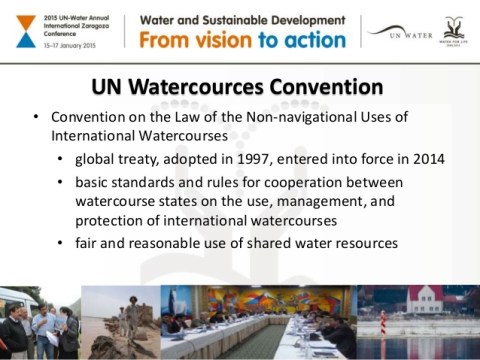
Sarstoon River and UN Watercourses Convention

watercourse convention“Today, the more balanced concept of ‘limited territorial sovereignty’ is widely accepted as the foundation upon which the law of international watercourses in general, and the UNWC in particular, have evolved. It stipulates that all watercourse states enjoy an equal right to the utilisation of a shared water resource, and that each watercourse state has to respect the sovereignty and correlative rights of other watercourse states – i.e. that it must not exceed its own right to equitable utilisation.” — (Theories of Allocation, from UN Watercourses’s Convention User Guide)

In many respects, the quote above is self explanatory, especially if one is even vaguely acquainted with the principles of international customary law that have been enshrined in the United Nations Watercourses Convention (UNWC). But the situation in the Sarstoon River, the international watercourse that forms Belize’s southernmost border with Guatemala, demands that a closer look be given to the principle of limited territorial sovereignty, as enshrined in the UNWC, and to the principle of community of interest.

Continue reading

ICJ Debate Decontextualized?

“Belize must draw attention to the anomaly inherent in Guatemala’s limitation of its claim to the area of Belize lying south of the River Sibun. Guatemala’s position rests on its view of the function and operation of the 1859 Boundary Convention. This Convention relates to the boundary of the whole territory of Belize with Guatemala. If, as Guatemala contends, the Convention has come to an end, then it has come to an end in its entirety, and in relation to the whole territory of Belize. There is no basis for Guatemala’s arbitrary division of Belize into two parts–a northern part to which Guatemala claims no title and a southern part to which it claims title. There is a fundamental logical inconsistency in Guatemala’s position. If the position acknowledged in the 1859 Boundary Convention remains valid in relation to the North, it must equally remain valid in relation to the South. Guatemala needs to explain the basis on which it now distinguishes between two areas.” (Belize Position Paper and Response to Guatemala’s 1999 submissions, 2001) (Click Here to download Full Document)

Continue reading