Constitutionally Enshrined Checks and Balances (Part 2): Legislature oversees Executive

A few weeks back, as part of this ongoing conversation on checks and balances, we took a comparative look at the salient aspects of the Legislature’s ability to oversee and provide checks on Executive power (see Part 1 by Clicking Here). At the time, we used the world’s most popular democracy, the United States, as the benchmark (so to speak).

But as that article, published in the July 9th issue of The Reporter, made clear, the goal should not be to carbon copy the USA’s presidential system. The goal, instead, is to ask at least two fundamental questions: (a) what are the Parliamentary system’s analogous features that provide oversight of the Executive, and (b) how do Belize’s systems stack up next to the equivalent Parliamentary benchmarks.

Continue reading

BACKBENCHERS! IT’S A MATTER OF PRINCIPLE

We knew it was coming for months, but there’s something in the actual tabling of the People’s Constitution Commission Bill, 2022, that has brought the point home: Belizeans are, in fact, about to embark on a journey to revise our Constitution.

The functions of the Commission are fairly straightforward and delineated in section 6 of the Bill: (a) Conduct a comprehensive review of the Belize Constitution, and (b) prepare and submit to the Prime Minister a final report on its findings of the review.

As is to be expected, the Commission is also expected to carry out this work in a predominantly consultative fashion. For its part, the Bill adds, “For the purpose of sub-section (2) [which addresses how the Commission should go about this work], the Commission shall afford the people of Belize, both within and outside the country, to the extent practicable, the opportunity to freely express their opinions and make suggestions on matters they feel should be considered in the Constitution.”

This is good. This type of process should be as broad-based and as consultative as possible. Of course, this also means that the Commissioners’ work will be cut out for them, given that broad-based also signals wide-ranging and disparate views on what should remain and what should change within the Constitution.

BASIC CONSTITUTIONAL PRINCIPLES

Now, whatever the recommended changes will be, there are at least five principles that are likely to be enshrined in a democratic country’s Supreme Law: (i) Individual Rights, (ii) Popular Sovereignty, (iii) Separation of Powers, (iv) Checks and Balances, and (v) Limited Government.

The first is somewhat self-explanatory, as this speaks to the protection of the fundamental rights of every citizen. Part II of Belize’s Constitution covers these rights, which include the right to life, freedom, protection from inhumane treatment, and protection of your freedom of movement.

The second principle, Popular Sovereignty, is what gives us our representative democracy, as it is understood that governmental authority emanates from the people. It is for this reason the Constitution protects the “voice” of every voter.

Separation of Powers is also enshrined in the Constitution by way of the three branches of Government: The Legislature, Executive, and Judiciary. Of course, in a Parliamentary Democracy, there is often criticism surrounding the blurred lines between the Legislative and Executive arms of government.

Limited Government speaks to the fact that powers of government should be curtailed by the Supreme Law. From the vantage point of the rule of law, the prime minister and no other member of government can be deemed to have unlimited powers or “above the law.”

Finally, we arrive at the fifth principle: Check and Balance. I saved this one for last, as this principle is the primary focus of this Res Publica360 entry. Fundamentally, Checks and Balances are systems designed to keep the various branches of government in line. The Legislative branch, for instance, is to oversee the executive.

BACKBENCHERS: BUILT-IN CHECK & BALANCE?

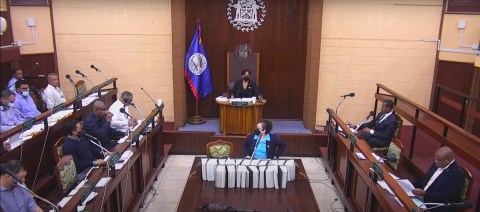
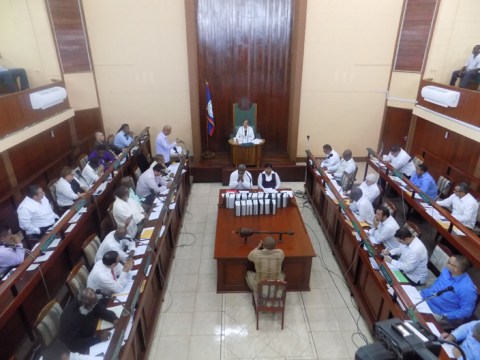
One form of check and balance (CnB) that is seldom discussed in Belize is the so-called “backbenchers” role in Parliament. Remember what I had said above: The Legislative arm is intended to oversee the executive’s policies. This job should not only fall to the Opposition but also to these backbenchers.

Let’s use present-day examples. Currently, the People’s United Party (PUP) makes up the majority, with its members holding 26 out of the 31 seats in the House of Representatives. And, given our system, the members of the Cabinet, led by the Prime Minister (who is the leader of the majority party), are likewise made up of persons from among that 26.

By definition, backbenchers are members of Parliament who are not members of the Cabinet and are supposedly free of the so-called “payroll vote.” But that’s a fairly narrow definition. The Institute for Government, a think tank, uses a much more liberal definition when discussing the “payroll vote:”

The term ‘payroll vote’ has traditionally been used to describe MPs [members of parliament] who hold positions from which they would have to resign in order to oppose the government. This includes paid and unpaid positions. The term can also include roles which do not formally bind MPs to vote with the government, but may have been given out by the prime minister in order to reward or encourage loyalty. This is the wider payroll vote.

Did you “hear” that? These paid (or unpaid) positions may “bind” Members of Parliament “to vote with the government.” And there you were, thinking that at least those non-Cabinet ministers were free to vote according to the needs and wishes of their constituencies or, at least, their conscience. Sorry.

Elliott Bulmer (2017)’s work, entitled “Government Formation and Removal Mechanisms,” does an excellent job of summarizing how authorities have worked to dilute the ability of backbenchers to be free enough to challenge their own party’s policies. Bulmer (2017, p. 35) states:

“The doctrine of collective responsibility means that ministers cannot vote against the government in parliament…The ‘payroll vote,’ as it is called (because ministers are on the government’s payroll), can be very influential in securing the loyalty and obedience of backbench parliamentarians. Governments may attempt to appoint oversized cabinets, or a LARGE NUMBER OF JUNIOR MINISTERS, to increase the influence of the payroll vote. As well as weakening parliament, this tactic can lead to a bloated inefficient government.

“To prevent this, some constitutions place limits on the number of ministers that may be appointed and hold office at any time. The Constitution of India (article 75), for example, restricts the number of ministers to 15 per cent of the total number of members of the lower house.”

BELIZE’S CONSTITUTION AND THE PAYROLL VOTE

As Bulmer (2017) highlighted, prime ministers in parliamentary democracies have an incentive to effectively purchase obedience and loyalty from their party folks; thereby, minimizing the possibility that non-Cabinet members of his own clan could too easily challenge the Cabinet’s policies.

[It is worth keeping in mind that Belize’s Constitution—since the last Constitutional reform—has anti-defection provisions which prevent “crossing the floor,” which is yet another source of protection for the prime minister of the day. But anti-defection is a topic for another time].

The Belize Constitution tries to defend against the payroll vote in section 40(2), which states:

Provided further that the CABINET shall be comprised of, (a) not more than TWO-THIRDS of the elected Members of the party that obtains the majority seats in the House of Representatives following the holding of a general election.

Keeping with the current majority, that provision limits the PUP to about 17 ministers. And, of course, the administrations—past and present—have done well to satisfy that part of the law.

So, in theory, all things being equal, at least nine members of the PUP majority in the House of Representatives should be free of the payroll-vote noose. And, where necessary, these free men and women could call—if even politely—their own government colleagues back into alignment with sound public policy.

But, of course, as pointed out by Bulmer (2017), this fairly weak proviso in the Supreme Law leaves the door open to Junior Ministers, or what is often called “Ministers of State.”

How so? Section 40(2) of the Constitution considers only Cabinet members, but as section 44 of the Constitution makes plain, a “Minister of State…SHALL NOT be a member of Cabinet.” So, there you have it. Junior Ministers are paid from the public purse, and, therefore, whatever little flicker of criticism that could have emerged from the backbench is muffled by the expanded payroll vote. And here’s the kicker! Under the current language of Section 40(2) of the Constitution, it’s perfectly legal!

AMENDING SECTION 40(2)?

Okay. So this brings us full circle. I started this off by talking about the basic principles governing any democratic Constitution. As we move into the Constitutional reform process with those principles serving as guiding lights, the Belizean people—among many other things—will also have to examine the strength (or lack thereof) of these so-called check-and-balance institutions.

If we borrow from the criminologists’ “broken window” concept, we could say that we ought not to let even the smallest crack in our oversight mechanisms go unattended. The payroll vote is one such small crack.

Consequently, as we move towards this extensive exercise of reviewing the Belize Constitution, this is one area that is worthy of our attention. And it should force upon us this question: Should section 40(2) of the Constitution be amended to include not only Cabinet members but also any paid government office to which a Member of Parliament could be appointed, with the expressed goal of limiting the payroll vote?

We shall see where this issue lands on the reform agenda. For now, it could only be hoped that it will all boil down to a matter of principle for most of us.

MANDATORY VACCINATION CAN BE JUSTIFIED BUT CONTEXT VITAL

“The main rule within international human rights law is that vaccination, like any other medical intervention, must be based on the recipient’s free and informed consent. This rule is, however, not absolute. In Solomakhin v Ukraine, the European Court of Human Rights (the Court) held that mandatory vaccination interferes with a person’s right to integrity protected under Article 8 of the European Convention on Human Rights (ECHR). Nevertheless, the Court concluded such interference may be justified if considered a ‘necessity to control the spreading of infectious diseases’ (para 36).”— Nilsson, Anna. “Is Mandatory Vaccination Against COVID-19 Justifiable Under the European Convention on Human Rights?” GC Human Rights Preparedness, 15 April 2021.

ON THE HUMAN RIGHTS SIDE

Okay, so let’s get this part out of the way from early: Yes, the opening quote above is directly relevant for the European Union & its ECHR. So yes! It does not set any binding precedent for the Caribbean; and specifically, it does not set the pace here in Belize. At best, these extra-regional judgments could only carry “persuasive” weight, as I’ve been informed by legal minds.

Nonetheless, let’s face it: many binding Human Rights treaties cite the same source—the Universal Declaration of Human Rights and the other conventions that collectively give us the so-called “international bill of rights.”

Therefore, the European Convention on Human Rights (ECHR) shares a similar “foundation” with other conventions such as the AMERICAN CONVENTION ON HUMAN RIGHTS. And, it must be said, whether countries have signed onto these conventions or not, there is no secret that they have been known to carry some influence in domestic and regional legal deliberations.

So, on the human rights side of things, more and more courts are going to be asked to rule on this matter, and one ought not be surprised when the judgments come back tilting in favor and support of context-specific state-sponsored mandatory COVID vaccination policy.

Continue reading

The UDHR: THE VACCINE AGAINST DICTATORSHIP

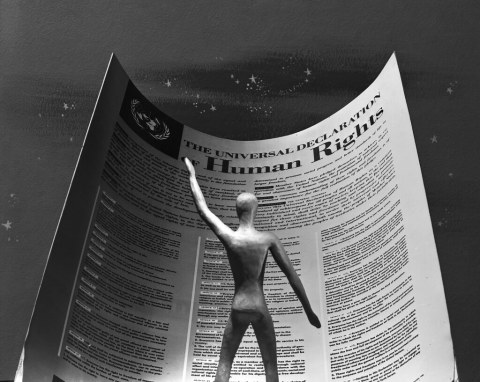
Article 21 of the UN Declaration of Human Rights (UDHR) reads: “(1) Everyone has the right to take part in the government of his country, directly or through freely chosen representatives; (2) Everyone has the right to equal access to public service in his country; (3) The will of the people shall be the basis of the authority of government; this will shall be expressed in periodic and genuine elections which shall be by universal and equal suffrage and shall be held by secret vote or by equivalent free voting procedures.”

The language seems self-explanatory, but it is still worth looking closer at how we should interpret those words, especially as it pertains to the conceptualization of the will of the people. In answering this question (among others), the United Nations Human Rights Office of The High Commissioner (OHCHR) wrote:

Fresh in the minds of the UDHR drafters was the election of Adolf Hitler through democratic processes, and his subsequent rejection of the very same processes as a foundation for the democratic state. … Such a leader would command total obedience from those under him, and he was above, and therefore could totally disregard, the rule of law. In this respect, like so many others, the UDHR can be seen as a key part of the world’s attempt to inoculate itself against any future would-be dictators” (full statement published in this issue of The Reporter).

Continue reading

Tinkering with the Constitution

Since Independence there have been eight amendments to the Belize Constitution. In 1985, there was the Belize Constitution (First Amendment) Act (No. 14 of 1985), which, inter alia, addressed certain nationality matters, including the issue of Dual Nationality as found at Section 27 of the Constitution.

Three years later, the records show that there was the Second Amendment Act (No. 26 of 1988), which, again among other things, gave us the Elections and Boundaries Commission (Section 88). The third amendment came thirteen years later in 2001, with the Belize Constitution (Third Amendment) Act, 2001 (No. 2 of 2001). The third amendment was fairly extensive and impacted the operations of the Public Service Commission (PSU), looked at the Security Service Commission, touched on the tenure of office of Justices of the Supreme Court, and even made changes relevant to the Cabinet.

In the same year, there was also the Fourth Amendment (No. 39 of 2001), which looked at the Belize Advisory Council (BAC), and, inter alia, amended areas relevant for the functions of the Senate. Four years later there was the Fifth Amendment (No. 23 of 2005) that looked at the Magistracy (Section 93A) and “Remuneration for certain officers” (section 118).

The Sixth Amendment would follow three years later (No. 13 of 2008) and it made changes to several areas of the Constitution, including section 17 which provides “protections from deprivation of property”. It would take another two years before the Seventh (No. 4 of 2010) arrived to make changes that included those relevant for the appointment of Ministers of Government (section 40), especially as it pertains to the appointment of the Attorney General.

And then, of course, there’s the infamous Belize Constitution (Eight Amendment) Act, 2011, which was predominantly designed for the Government to maintain control of the Public Utilities. Its purpose is probably best articulated in the amendment made to section 144 of the Constitution which now reads: “From the commencement of 25th October, 2011, of the Belize Constitution (Eight Amendment) Act, 2011, the Government shall have and maintain at all times majority ownership and control of the public utility provider.”

There is always room to debate the changes made over the years, especially in terms of the Eight Amendment, which was soaked in controversy. However, it cannot be ignored that those eight amendments occurred over the span of almost three decades—from 1985 to 2011.

The People’s “CONTRACT”

The Constitution could succinctly be defined as the codification of the Will of the People. This is part of the reason why the Constitution of Belize’s preamble opens with the phrase: “WHEREAS the people of Belize”. More than anything, this is the People’s document, which provides, at least, three basic functions: (a) to first and foremost provide protections for citizens’ individual liberties and rights, (b) secondly, to give life to “trias politica” (Separation of Powers) principles, and (c) closely related to trias politica, establishes a government that should be “of the people, for the people, by the people”.

One could, therefore, think of the Constitution as the “supreme contract” between the People of Belize (the true rulers in a democracy) and the Government of Belize (GoB).

Now, for any commonplace contract, it is common knowledge that terms in a contract cannot be unilaterally altered. The Parties to the Contract are required to communicate—in one form or the other—whether they agree to any alterations. Keeping, then, with this analogy, one would be right in asking the question: How do the People of Belize communicate our desire for (a) any change to the People-to-Government Contract, and (b) upon deciding that there is indeed a desire for some change, how do we go about deciding on exactly what those changes ought to be?

The “Curse” of the Supermajority

There is space for quite a robust debate as one tries to answer that question; however, the post-independence trend seem to suggest that at least one party to the “supreme contract” believes that the answer lies in the results at the polls.

If one would review the First through Eight amendments, a conspicuous pattern emerges: That is, changes to the Constitution are made whenever one political party wins a “supermajority”. In 1985 and 1988, the United Democratic Party (UDP) controlled 21 out of the then 28 seats in Parliament, thereby, giving it well above the two-third votes required for Constitutional amendments.

The “silence” between 1988 and 2001 could be largely attributable to the fact that no such supermajority re-emerged until 1998, when the People’s United Party (PUP) won 26 of the then 29 Parliamentary seats. It took about two years, but eventually the PUP started their own tinkering with the Constitution, giving us the Third and Fourth Constitutional amendments in 2001.

Having maintained dominance in House after the 2003 General Election, with the voters giving the PUP 22 seats in the House of Representatives (“The House”), it took the Musa Administration about two years before they instituted the Fifth Amendment in 2005.

Then, of course, most would recall the results of the 2008 General Elections, wherein the UDP was returned to office with a supermajority (25 to 6 seats). This era gave us the remaining three changes to the People’s contract (i.e. the sixth to the eight amendments). The subsequent General Elections didn’t yield a supermajority; therefore, for roughly ten years there were no changes to the Belize Constitution.

Last November, however, the people, once again, returned a supermajority to The House, giving the PUP 26 out of the 31 seats. And while the Musa Administration seemed to have applied a two-year “buffer” before pulling the Section 69-trigger, that does not seem to be the case with the present administration, which as proposed three in about eight months.

A Mandate?

Several things are observable from this trend. First, the fact that changes only seem to occur when one party enjoys a supermajority in the House is indicative of an inability or unwillingness of politicians to obtain bi-partisan support for the changes. The second observation is that political parties seem to take the view that the size of their victory at the polls directly signals the People’s “permission” or “support” for Constitutional Amendments.

The second point, however, is the most salient. The Belizean people will have to “speak up” (as the saying goes) as to whether or not a “big win” at the polls should be automatically interpreted as carte blanche license. The fundamental principle governing the “supermajority” requirement is that democracies should carefully deliberate Constitutional alterations; they ought not to be done whimsical or for political expediency.

Tenth and Eleventh Amendments

To that end, it cannot be lost the Belizean People that in just under eight months, the current government is in the process of proposing three amendments, with the tenth and the eleventh amendments being the most troubling of the bunch.

In the case of the Belize Constitution (Tenth Amendment) Bill, 2021, the government is seeking to change the tenure rules for members of four Constitutional enshrined institutions: The Belize Advisory Council, the Elections and Boundaries Commission, the Public Services Commission, and the Security Services Commission. Essentially, if passed, the proposed change would make each of these important institutions subject to the political cycle.

The Eleventh Amendment—at least based on what has been circulated in the media thus far—seeks to add new disqualifications for persons vying to become members of Parliament. If passed, this amendment would cause the Supreme Law to read as follows:

“No person shall be qualified to be elected as a member of the House of Representatives who … (da) has served a sentence of imprisonment for more than twelve months, imposed by a court in or outside of Belize; or (db) is under a sentence of imprisonment, or has served a sentence of imprisonment, imposed by a court in or outside of Belize, for an offence in relation to corruption or abuse of public office.” Clearly, there is some value in the latter provision, so as to ensure that proven corrupted officials cannot hold the reins of power. However, the citizenry must carefully weigh whether the former section (da) reflects the will of the Belizean People. The same question ought to be asked of the Tenth Amendment.

Minimizing the “Payroll Vote” in Parliament


This week, once again, I saw a media interview in which the journalist was making ‘probing’ questions as to whether or not a newly elected area representative (AP) feels disappointed that he was not ‘rewarded’ with a ministerial portfolio after having won in a UDP stronghold. … sigh….😞I’ve been saying it for years, but let me try to be as succinct as I can this time.
Here goes: “The less Area Representatives appointed to Cabinet, the BETTER FOR the people in terms of checks and balances against an incumbent prime minister and his government.”

Continue reading

Duties of ‘Area Reps’ may not be what we commonly think

#DutiesOFareaREPs

The first duty of a member of Parliament is to do what he or she thinks in his or her faithful and disinterested judgement is right and necessary for the honour and safety of Great Britain. His second duty is to his constituents, of whom he is the representative but not the delegate. … It is only in the third place that his duty to party organization or programme takes rank. All these three loyalties should be observed, but there is no doubt of the order in which they stand under any healthy manifestation of democracy.

— Winston Churchill, Duties of a Member of Parliament (c.1954–1955)

Whether one likes or dislikes Churchill as a historical figure, it is hard to find fault with this quote regarding the duties of MPs, who for us in Belize are commonly referred to as “Area Representatives” (APs). For our purposes here, let’s call this the ‘Churchillian Hierarchy of APs’ Duties’.

Interestingly, however, despite all the attention and fanfare we give these APs, have we realized that the rubric we use to grade these APs is a bit inaccurate? Let me explain what I mean.

Section 89(2) of the Constitution says: “Each electoral division shall be represented in the House of Representatives by one elected member”. Good. We know this. We also know what the House of Representatives is, correct?

Section 55 of the Constitution establishes the LEGISLATURE, which is comprised of two Houses: The House of Representatives and the Senate. Then, in section 68 of the Constitution, this Legislature is given law-making powers for “the peace, order and good government of BELIZE”. Notice it didn’t say “of the particular Electoral Division that the AP represents”.

As a result, we may take some liberties and rewrite Churchill’s quote above thus: “The first duty of an Area Representative is to do what he or she thinks in his or her faithful and disinterested judgment is right and necessary for the peace, order and good government of BELIZE”. Continue reading

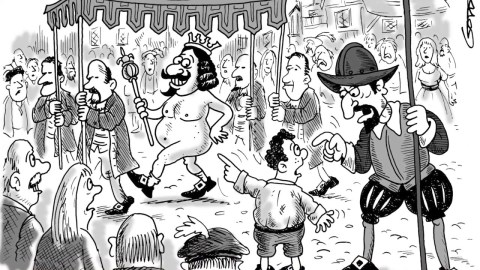
Mischaracterization of democracies’ Emperors in the tale of the Emperor who hath no clothes

Most of us are likely somewhere between casually or intimately familiar with the Hans Christian Andersen story titled “The Emperor Haas No Clothes“. It’s a popular tale that has an important object lesson, and for this reason it is often employed as a metaphor for gullibility of the people in power, be they Presidents or Prime Ministers or established politicians in general. And for the most part, that interpretation is understandable, while yet, in my humble view, grossly mischaracterised.

The object lesson can certainly stand the test of time; however, the unfortunate mischaracterization begins at the very top: The King. For all intents and purposes, the king in a Democracy is not the elected official in the persona of a President or a Prime Minister or any member of Parliament for that matter. If one would recall the etymology of the word “Democracy” as being found in the Greek word “demoskratia”, it would then be recalled that therein the “demos” part of the word can be translated as “common people”. The latter half of demoskratia hails from the Greek word “kratos” meaning rule. When combined, the word speaks to the rule by the common people. One definition describes democracy as “system of government in which the sovereign power is vested in the people as a whole exercising power directly or by elected officials.” Therefore, the “Emperor” in this timeless tale (at least as far as a democracy is concerned) is the citizenry or the common man and woman. Continue reading

From Chavismo to ‘Madurismo’

“Under capitalism, man exploits man; under communism, it’s just the opposite.”–John Kenneth Galbrait.

I’ve found myself quoting Galbrait a lot lately, especially when looking at the happenings in our South American neighbor, Venezuela. However, I’d be the first to admit that it’s applicability to the current happenings in Venezuela is not as perfect, because as I’ve written in an earlier post, while there are natural overlaps between economic ideologies and the sociologists’ definition of political systems, the two are not the same.  Continue reading

From Left-wing populism to authoritarianism

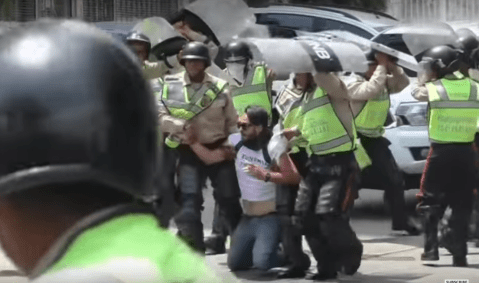
Venezuela’s path to undoing its democracy amidst ‘Petro-Muzzled’ region

Traditionally, whenever the topic of Venezuela is discussed or written about, the stories are almost always framed as the Davidesque struggle of a Leftist regime against the Goliathan evils of the economic Right. Essentially, such characterisations are not necessarily invalid, because Venezuela’s government remains committed to its socialist principles, while resisting the tenets of its more conservative counterpart.

However, since the days of Chavez to the present times of his hand-picked successor President Nicolas Maduro, the issue is becoming less about capitalism challenging socialism and more about authoritarianism supplanting democracy–the ostensibly natural outcome of populism.  Continue reading