From Chavismo to ‘Madurismo’

“Under capitalism, man exploits man; under communism, it’s just the opposite.”–John Kenneth Galbrait.

I’ve found myself quoting Galbrait a lot lately, especially when looking at the happenings in our South American neighbor, Venezuela. However, I’d be the first to admit that it’s applicability to the current happenings in Venezuela is not as perfect, because as I’ve written in an earlier post, while there are natural overlaps between economic ideologies and the sociologists’ definition of political systems, the two are not the same.  Continue reading
From Left-wing populism to authoritarianism

Venezuela’s path to undoing its democracy amidst ‘Petro-Muzzled’ region

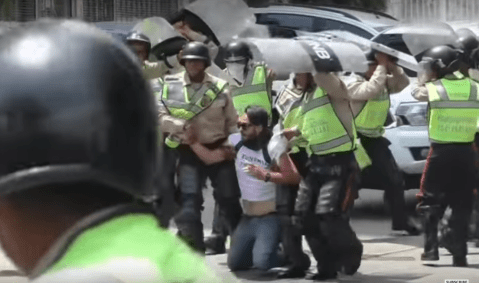
Traditionally, whenever the topic of Venezuela is discussed or written about, the stories are almost always framed as the Davidesque struggle of a Leftist regime against the Goliathan evils of the economic Right. Essentially, such characterisations are not necessarily invalid, because Venezuela’s government remains committed to its socialist principles, while resisting the tenets of its more conservative counterpart.

However, since the days of Chavez to the present times of his hand-picked successor President Nicolas Maduro, the issue is becoming less about capitalism challenging socialism and more about authoritarianism supplanting democracy–the ostensibly natural outcome of populism.  Continue reading

Sarstoon River and UN Watercourses Convention

watercourse convention“Today, the more balanced concept of ‘limited territorial sovereignty’ is widely accepted as the foundation upon which the law of international watercourses in general, and the UNWC in particular, have evolved. It stipulates that all watercourse states enjoy an equal right to the utilisation of a shared water resource, and that each watercourse state has to respect the sovereignty and correlative rights of other watercourse states – i.e. that it must not exceed its own right to equitable utilisation.” — (Theories of Allocation, from UN Watercourses’s Convention User Guide)

In many respects, the quote above is self explanatory, especially if one is even vaguely acquainted with the principles of international customary law that have been enshrined in the United Nations Watercourses Convention (UNWC). But the situation in the Sarstoon River, the international watercourse that forms Belize’s southernmost border with Guatemala, demands that a closer look be given to the principle of limited territorial sovereignty, as enshrined in the UNWC, and to the principle of community of interest.

Continue reading

ICJ Debate Decontextualized?

“Belize must draw attention to the anomaly inherent in Guatemala’s limitation of its claim to the area of Belize lying south of the River Sibun. Guatemala’s position rests on its view of the function and operation of the 1859 Boundary Convention. This Convention relates to the boundary of the whole territory of Belize with Guatemala. If, as Guatemala contends, the Convention has come to an end, then it has come to an end in its entirety, and in relation to the whole territory of Belize. There is no basis for Guatemala’s arbitrary division of Belize into two parts–a northern part to which Guatemala claims no title and a southern part to which it claims title. There is a fundamental logical inconsistency in Guatemala’s position. If the position acknowledged in the 1859 Boundary Convention remains valid in relation to the North, it must equally remain valid in relation to the South. Guatemala needs to explain the basis on which it now distinguishes between two areas.” (Belize Position Paper and Response to Guatemala’s 1999 submissions, 2001) (Click Here to download Full Document)

Continue reading

What Guatemala can’t prove before the ICJ!

Three years ago, in THE REPORTER’s “Road to Referendum” column, the generalities of Belize’s legal position against the Guatemala claim were discussed. The column’s articles were founded predominantly on the “Legal Opinion on Guatemala’s Territorial Claim to Belize” (henceforth referred just as the Legal Opinion), written in the early 2000’s by a quadripartite of the best minds in international law.

The first installment in that brief “Road to Referendum” series, entitled “Belize Legal Position Part One”—which could still be found on The Reporter’s website—outlined briefly some of the cornerstone arguments that have led pretty much every legal professional to declare that Guatemala has no case, while simultaneously underscoring the “ironclad” nature of our position. Continue reading

Belize-Guatemala Dispute and Bilateral Trade

The recent escalation of tensions between Belize and Guatemala, especially following the latter’s apparent sidestepping of the confidence building measures, is something for the international economic relations’ textbooks and scholarly journals. Particularly, if the recent reports by the Belizean media of declining bilateral trade in Melchor de Mencos are accurate, then the Guatemalan government has just become a real-time confirmation of what recent international relations research have predicted.

For instance, in a 2015 study by Ryan Brutger and Austin L. Wright, entitled “The Costs of Conflict: Border Disputes and Trade Diversion”, it was found that two things are likely to happen “when a dispute between two states becomes particularly intense”: bilateral trade declines by “an average of 82%”, and it is likely that trade with third party, non-disputing trading partners increases by 2.5%.   Continue reading