A Balanced and Evidence-based Approach to Minimum Wage Adjustments

As the conversation on a minimum-wage adjustment develops, it is good that all stakeholders agree—even the business community, as articulated in a recent interview with the Belize Chamber of Commerce and Industry (BCCI)’s President—that an uprate to the minimum wage is necessary.

Additionally, most stakeholders appear to agree that the best way to approach it is by having a minimum-wage-adjustment formula serving as the guide post. That is also a good thing.

The agreement in those two BROAD areas is a great start. However, there are a few technical things that must be highlighted.

BALANCED AND EVIDENCED-BASED

Let’s start here. The likes of the International Labour Organization (ILO) have advised that a Balanced and Evidence-based Approach (BEA) be employed when making uprates. What’s a BEA? Simply put (and is consistent with the ILO’s Minimum Wage Fixing Convention, 1970) is for policymakers to consider the needs of workers, the conditions of the economy, and the ability of enterprises to actually afford the increase.

Candidly speaking, policy always has to consider, inter alia, the ability of the regulated entities to comply with the change. This is why, no one—with a straight face—has uttered that the minimum wage should increase to something like $20 per hour.

More precisely, the ILO, in its minimum wage policy guide, puts it like this:

“A balanced approach is one that takes into account, on the one hand, the needs of workers and their families and, on the other, economic factors.

“Such an approach combines both social and economic factors in order to find a level that benefits workers and society WITHOUT PROMPTING NEGATIVE EFFECTS. A balanced approach is necessary because a minimum wage is a redistributive tool that has both BENEFITS and COSTS.

“If set too low, minimum wages will have little effect in protecting workers and their families against unduly low pay or poverty. IF SET TOO HIGH, minimum wages will be poorly complied with and/or have ADVERSE EMPLOYMENT EFFECTS.”

CHANNELS OF ADJUSTMENT

Before proceeding, there is value in discussing these “effects” alluded to by the ILO and others, as there is a need to expand the paradigm on this subject.

Frankly, the economic literature on MW changes has long since moved towards recognizing that there are many likely channels of adjustment (CoAs) associated with an MW change.

As pointed out by economists such as John Schmitt (2013) and Hirsh et. al (2015) there are POTENTIALLY multiple CoAs. Schmitt, for his part, identified at least ELEVEN that COULD follow an MW increase. These are (1) Reduction in hours worked, (2) Reduction in non-wage benefits (bonus, health insurance, pension contributions), (3) Reductions in training, (4) Changes in employment composition, (5) Higher prices, (6) Improvements in efficiency, (7) Efficiency wage response from workers, (8 ) Wage compression (slower increases for non-MW workers), (9) Reduction in profits, (10) Increase in (consumer) demand, and (11) Reduced turnover.

Now, please notice the use of the words “potential” and “could.” This area of economics is still evolving and many times the results are inconclusive across disparate research works. Nevertheless, there is value in keeping these adjustment channels in mind, as we discuss adjustments to the minimum wage.

Additionally, it is clear that not all of those eleven CoAs are “bad.” Now! Which of those 11 CoAs will dominate in Belize? Well! That should be the subject of our own idiosyncratic research. Remember. Each economy is like fingerprints: Unique, and thus requires unique, research-based attention.

THE FORMULA

The CoAs and the need for a balanced approach are, among other things, the key motivators for a formula-based approach to be utilized. Countries such as Costa Rica employ a formula that looks at the consumer price index (CPI)’s changes alongside the state of the economy, while still preserving the indispensable role of the social partners.

In other jurisdictions, other variables such as the poverty line, productivity measures, and more have been incorporated into their formula in an effort to balance the needs on both sides of the labour market.

Most importantly, the formula-based approach is more predictable, frequent, and structured.

Hypothetically speaking, if since 2012, a formula had been utilized to guide changes on either an annual (or biennial) basis, and those changes were incremental, it is likely that the conversation TODAY would NOT be about jumping from $3.30 to $5.00, which is a significant 51% increase that already struggling employers would have to find! Considering the inflationary times, that pill would be a lot for micro, small, and medium-sized enterprises (MSMEs) to swallow virtually overnight.

If this process had benefited from more frequent updates (annually or biennially), then change might have been well below a 10% uprate (as opposed to more than 50%). Too sudden of a shift may summon the more negative members of that eleven-point list of CoAs mentioned above.

MEDIUM-TERM STRATEGY

For this reason, the ILO’s advice on medium-term MW strategy is also instructive:

“Many countries have discovered that a GAP exists between the legitimate needs of workers and their families and what the ECONOMY IS CAPABLE OF PAYING IN TERMS OF MINIMUM WAGES. It will NOT be possible to eliminate this gap in a SINGLE MINIMUM WAGE ADJUSTMENT, at least NOT WITHOUT ADVERSE ECONOMIC EFFECTS.”

“This suggests that there should be a medium- to long-term target for this policy – that is, closing this gap in SUCCESSIVE, GRADUAL adjustments.”–ILO (2016, p. 52, at Link 1).

In order for there to be a “gap” there has to be two sides: In this case, workers and employers. Often, the conversation on minimum wage ventures into decreeing that the needs of the workers are at least $5.00, $10.00 or more. And, from a cost of living standpoint, that may very well be true!

However, the other half of that GAP is whether the average micro, small, and medium-sized enterprises (MSME) can currently afford to fill those gaps practically overnight.

In short, then, the balanced and evidence-based approach is not an attempt to relegate or ignore the financial needs of workers in any economy. Instead, it rightfully recognizes that there are literally two sides of the equation, and the private sector’s ability to pay cannot be ignored.

ROLE OF SOCIAL PROTECTION PROGRAMS

Of course, the retort can easily be the old adage: “While the grass grows the horse starves.” Can a responsible set of policymakers truly implement a judicious set of incremental increases to the minimum wage, while believing (or maybe even confirming) that the needs of workers are much higher?

The short answer is “no.” But then, at this point, it becomes a debate on responsibility-sharing. While, yes, the workers should benefit more from their work via higher wages, in the interim this is where governments must step in with social protection and assistance programs that, among other things, help to fill the remaining “gap.” The minimum wage, therefore, cannot be the chief and only poverty-fighting strategy of policymakers; there is an urgent need for other social protection programs to be upgraded or introduced, and these include “graduation programs,” rent assistance initiatives, and more.

Graduation programs are worthy of some special attention. These types of social protection programs tend to include cash transfers to individuals or households (e.g. the individual may receive a stipend). Simultaneously, the beneficiaries are (mandatorily) enrolled in skills training programs, and thereafter are matched with productive employment opportunities. Fundamentally, at the end of a prescribed period of time, the participant should be able to stand on his or her own two feet either as a productive employee or an entrepreneur, and may very well be earning more than the legislated minimum wage.

To conclude, then, we must not lose sight of the real problem that we’re trying to address: Poverty. Do minimum-wage adjustments help (however little) ease poverty? The empirical literature says, “Yes.” But is this the only and permanent solution? From an inclusive growth and development point of view, the answer would be “no.” Initiatives like “Graduation Programs,” if done correctly, and in tandem with other robust social protection institutions, can help individuals climb socially and beyond minimum-wage levels.
Culture and Economic Systems

Maybe the use of the word “travesty” is quite possibly a bit of hyperbole; however, it is the word that comes to mind when one considers the usually narrow exposure most students and economists have with other economic systems. In most universities on this side of the globe, the textbooks “educate” most of us to extol and place on a pedestal one predominant form of the market economy and its inherent assumptions. Those assumptions become a form of cantillation, whereby, we begin to intone the ideals of the “rational consumer,” the “profit-seeking” entrepreneur, and the supposed allocative efficiency of the price mechanism in the market is apotheosized.  

While one cannot completely disregard the utility of some of the foundational assumptions when placed within their appropriate contexts, as the veils of ceteris paribus continue to lift, one component that is increasingly gaining traction within the Comparative Economics literature is the role played by the national cultural values. Said differently, at the heart of the traditional assumptions, there is the inherent and undergirding philosophy that economic agents are largely the same in terms of their driving force and incentives. But as we learn more via research, is that premise entirely true, especially when one recalls that every group of people carry with them their own set of cultural values that, in turn, define goals?

In 2020, the research duo, Thomas Bradley and Paul Eberle, published their paper that touches on this salient point (Bradley and Eberle 2020). Using the seminal work of Geert Hofstede (1980)’s Cultural Dimension Index (“CDI”), they examined the nexus between countries’ disparate economic systems and their CDI scores. The exercise confirmed what most social scientists may have already suspected: That there is an inextricable link between culture and the way people of a particular community or society go about solving economic problems.

The CDI and Systems

To help others appreciate Bradley and Eberle (2020)’s findings, we must digress a bit towards a brief explanation of the CDI’s domains. Since Hofstede (1980) first introduced the CDI, the index has advanced somewhat to now incorporate six dimensions: Power Distance, Individualism, Masculinity, Uncertainty Avoidance, Long-term Orientation, and Indulgence.  The six dimensions are scored from zero to 100.

High Power Distance (PD) speaks to a cultural dynamic that accepts power differences, with citizens of the country in question tending to show a great deal of respect for hierarchy and for those in authority and of rank. Countries like Saudi Arabia and Guatemala carry high PD scores (both at 95). Conversely, the United States and the United Kingdom have much lower PD scores at 40 and 35, respectively. The lower scores for the United States and the United Kingdom are not surprising considering their political structure and institutions.

A high level of Individualism (IND) speaks to the fact that such a society places a greater premium on individual goals and responsibilities. Inversely, low individualism is synonymous with a collectivist society where more weight is placed on the well-being of the collective or society as a whole. As Hofstede defines this dimension, IND can be defined as “a preference for a loosely-knit social framework in which individuals are expected to take care of themselves and their immediate families. Its opposite, Collectivism, represents a preference for a tightly-knit framework in society in which individuals can expect their relatives or members of a particular in-group to look after them in exchange for unquestioning loyalty. A society’s position in this dimension is reflected in whether people’s self-image is defined in terms of ‘I’ or ‘we.’” With that definition in hand, it should be of little surprise, then, to find that Venezuela’s IND statistic is found at the lower end at 12, while the United States’ IND has been set at 91.

Among other things, a society high in what the CDI has labeled as “Masculinity” (MAS) tends to place greater emphasis on competitiveness and “material rewards for success.” A lower score on MAS is said to speak to a preference for “cooperation, modesty, caring for the weak and quality of life. Society at large is more consensus-oriented.” Nordic countries like Sweden and Norway—which have strong welfare systems—are found to have very low MAS values of five (5) and eight (8), respectively. For the United States, the value here is 62, and for both China and the United Kingdom the score is 66 on the CDI. For the latter group (i.e. USA, China, and UK), the CDI signals their cultural preferences for more competition and material rewards, and less emphasis on consensus-building and “caring for the weak” as one may find in Sweden and Norway.

Uncertainty Avoidance (UA) has to do with the society’s risk appetite. More precisely, as Hofstede explains it, it has to do with the “degree to which the members of a society feel comfortable with uncertainty and ambiguity.” Consequently, high levels of UA may manifest itself as a society that prefers rigid codes and conservative behavior that is not very open to “unorthodox behavior or ideas.” Conversely, the lower rankers on UA are expected to have a higher tolerance for risk-taking—a key component of entrepreneurial activities and innovation.

Finally, Long-term Orientation (LTO) speaks to how societies approach preparing for the future. Higher rankers would tend to display an attitude of delaying immediate-term gratification in favor of long-term goals, while the lower scores on the LTO indicate a more short-term orientation that may manifest as a preference for immediate results and instant gratification. New Zealand is among the countries with fairly low (or short-term) LTO values as it scores at 33. On the other hand, China was found to display higher levels of LTO (87).

Return to Culture and Economic Systems

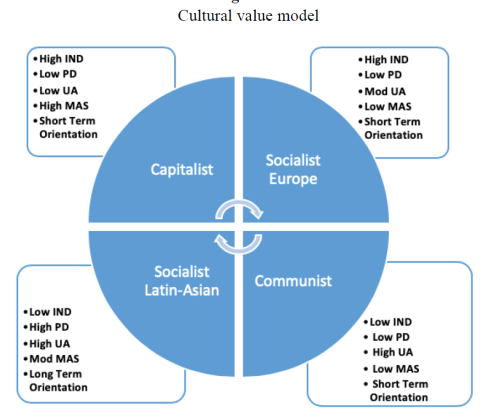
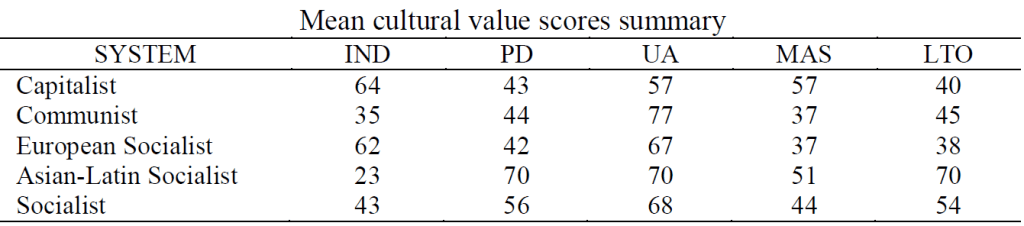
Having briefly reviewed the CDI, we are now able to return to the economic system’s conversation. Bradley and Eberle (2020)—using the mean scores among country groups—were able to demonstrate that countries with disparate systems resonated with their cultural values as measured by Hofstede (1980).

Grouping systems into five groups—a debatable approach considering the emergence of the tenets of the Varieties and Diversity of Capitalism schools of thought (see Hall and Soskice 2001, and Amable 2003)—Bradley and Eberle was able to show that each system had a unique relationship with the cultural dimensions. Capitalism, on average, displayed higher levels of Individualism (64), relatively low-to-moderate Power Distance (43), moderate Uncertainty Avoidance and Masculinity (57), and relatively low Long-term Orientation.

Communist countries, for their part, were found—unsurprisingly so—to display, on average, lower Individualism (35), low-to-moderate power distance (44), high levels of Uncertainty Avoidance, lower Masculinity (37), and low-to-moderate LTO. The lower MAS score for communist countries is to be expected considering that low MAS signifies societies that place greater emphasis on improving the “quality of life” of its members with relatively less focus on material achievements.

Source: Bradley and Eberle (2020)

An intriguing observation is that of the European Socialist economies that for the most part mirror “Capitalist” systems, save for the lower Masculinity value, which, again, prioritizes the welfare of the society’s members over material gains and competition.

Bradley and Eberle (2020) also classify certain countries’ systems into an Asian-Latin Socialist model. While both the European and the Asian-Latin wear the term “Socialist,” their expressions and approaches to achieving the goals differ significantly. On average, the Asian-Latin societies were found to have significantly lower values for Individualism (23) relative to the European model. Additionally, the manifestly higher levels of Power Distance (70), and Long-term Orientation (70).

The Institutional Channels

The shaping of a society’s economic system in alignment with its national cultural values (as measured in this instance via the CDI) is a testament to how culture, social norms, beliefs, and factor endowments influence the jurisdiction’s institutions.

In the Nordic countries, for example, we have already seen where their lower MAS score speaks to a society that prioritizes the “quality of life” of its members. As a result, among other interrelated factors, economic policy and institutions evolved in such a way to support a more welfare-oriented system. In Sweden, for instance, this welfare is pronounced in its publicly funded healthcare, education, and a host of social protection programs.

While Capitalist systems such as that found in the United States do have their fair share of social programs, the emphasis is notably different, especially when one tunes in to the ongoing policy debates in the USA over social spending.

Additionally, these formal and informal institutions are often times inter-generational as they are usually self-reinforcing. For this reason, the literature in this area of research holds the view that while there may be some cultural drift over time, the relative positions across varying societies are likely to remain unchanged.

A Place for a New Paradigm

Undoubtedly, the conversations on comparative economic systems are extensive, but the point being made here is that, as the world learns more about what informs the “design” of disparate economic systems, we should be prepared to simultaneously modify how we counsel economies. There is, therefore, a need for the crystallizing of a new paradigm as it pertains to economic policy advice, especially when this advice comes from external sources.

Ultimately, there is value in first comprehending the cultural dynamics of society before adopting economic policy positions. Practically speaking, to do anything less is to virtually doom the execution of incompatible policies to immediate or eventual failure. Even within the public-policy analysis domain—which is where Res Publica360 is written from—this latter point should resonate with the “value acceptability” consideration that is nestled within John Kingdon (1984)’s larger multiple streams model for agenda-setting.

The fact is that at the heart of national culture one will find societal “goals.” These goals can be quality-of-life specific á la the Nordic countries, or more focused on individualized material success. Similarly, these aims could emphasize long-term objectives such as environmental protection and sustainable development. Regardless of the goals, the point must be made that the standard assumptions—for decades—have unfortunately ignored these salient considerations under the themes of ceteris paribus, a “tool” utilized to simplify economic concepts but was never intended to lead the way. The inescapable truth is that all things are not equal, and this includes economic systems that are as unique as the societies’ cultures that build them.

Debt and General Elections: An Economic Argument for Campaign Finance Reform

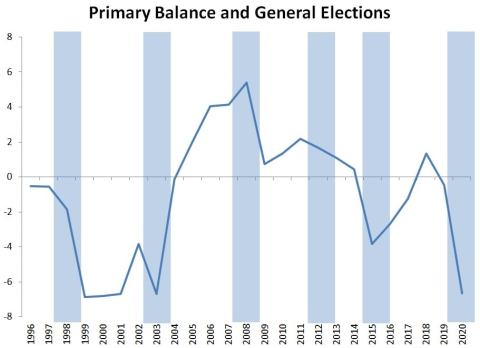
“There are also signals that the lack of fiscal discipline could be linked to political cycles. … In fact, the three years when the government’s budget balance reached its low-point before reverting towards balance (1984, 1993, and 2003) were election years”—Hausman and Klinger (2007, p. 13).

“According to the reported results, there is a POSITIVE RELATIONSHIP between elections and public debt accumulation. Given the positive effect, our evidence suggests that, relative to pre-election period, there is about 36% probability that presidential election periods are characterized by higher debt”–(Bayale et. al, 2020, p. 39).

The first opening quote above is from the “Growth Diagnostic of Belize” that had applied the Growth Diagnostic Framework and methodology to answering the age-old question: “Why is investment in Belize low?” In using the said framework—which has since been applied at least three times to the Belizean economy—researchers Ricardo Hausman and Bailey Klinger highlighted the fact that government’s fiscal balances tend to deteriorate just prior to a General Election.

The second is from a study entitled “More elections, more burden? On the relationship between elections and public debt in Africa.” In this one, Bayale et. al (2020) use data for fifty-one (51) African countries to empirically demonstrate the positive correlation between public-sector debt and Presidential Elections.

The intriguing thing about these studies is that while written roughly 13 years apart and about significantly different countries, the consensus remains: Without proper controls and institutions, prudent fiscal practices tend to go through the window around election time.

Continue reading

Restructure bond, restructure economy

Fundamentally, the Belize US-Dollar Bond 2038 (super bond) needs to be restructured based on several factors. Probably none more clear-cut than the simple reality that global and regional growth are not expected to be as robust as one may hope. But the bond restructuring is only but one part of a much more comprehensive “restructuring” that we need to look at, but we are yet to adequately address the underlining causes as to what brought us to this point.

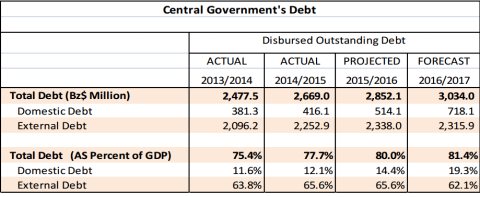
The origins of the Super Bond could somewhat be well summarised as being a mix of expansionary fiscal policies that rapidly increased the average government deficit from 3% to 9% of GDP within a span of about six year; climbing public debt, much of which was sourced from external sources who, on account of our declining credit ratings, kept increasing the costs at which we borrowed; and widening current account deficits.

As was pointed out in the working paper  “Sovereign Debt Restructurings in Belize: Achievements and Challenges Ahead” by Asonuma et. al (2014):

“At the same time, Belize’s external condition became more challenging owing in part to
high world oil prices, declining export prices, and rising external debt service costs.
Trade imbalances, coupled with surging debt service burden, led to significant current
account deficits, which averaged 17.3 percent of GDP during the period 2001 through 2005.
The large current account deficits were principally financed through a build-up of external public debt, which almost tripled from less than US$400 million in 1998 to US$1.1 billion in 2005.”

Without venturing into any in-depth analysis of the period between 1998 and the first restructuring in 2007, ideally, one key lesson here is the need for our government and people to take care on how we spend and increase our expenditures. That much, one could say, is within our control. And, it’s prudent to do so because we all know that there are factors such as global commodity prices, natural disasters, and even changes in the global and regional economy that are outside our control, to name a few.

A look at the Global and Regional Landscape

Speaking of factors outside of our control, this conversation would be incomplete without at least a brief look at developments in the global and regional economy.

In terms of the entire Latin America and Caribbean (LAC) region, average growth for 2016 and 2017 has been forecast at -0.6% and a meagre 1.6% growth for 2016 and 2017, respectively. The expectation is that the weakened global demand and trade that led to the negative outlook for 2016 would have tapered off by 2017. The International Monetary Fund (IMF), speaking on this point in its October 2016 Regional Economic Outlook Update, elucidated, “Growth is expected to rebound to 1.6 percent in 2017 (0.1 percentage point higher than in the April projections), as global demand gradually picks up and domestic policy uncertainty declines. Medium-term projections continue to be subdued, with the region expected to grow a mere 2.7 percent.” Continue reading

Who Dropped the Ball with NCL?

“I think the tourism representatives may be able to speak directly to that issue. From the very onset of those negotiations, it was clear that the NCL ships will be sent down south that would create some opportunity for the southern region of Belize.As you know that is the most impoverish in terms of opportunities. And so, I am not sure what negotiations FECTAB had, if any, with NCL in terms of being facilitators of tours here in the Belize District. I know that there are a number of tour operators and tour guides in the south who have prepared themselves to benefit from the NCL project in that area. But I don’t have the finer details and I think the tourism representatives can add some more value to that discussion.”–Minister of State Tracy Panton

Based on the level of data made public, I could certainly appreciate why FECTAB members would be alarmed at the “recent” developments as it pertains to Norwegian Cruise Line (NCL)’s Harvest Caye project and the potentially negative impacts it could have on FECTAB members’ revenues.

Nevertheless, this, in my opinion, is what happens when there are a couple of things absent from the public sphere: (a) a large news consumer base that incentivizes the media to keep these types of issues in the fore, (b) limited appreciation of the truly competitive and fluid nature of business, and (c) requisite communication (including listening) skills, preparation and negotiating skills from some key public and private-sector stakeholders.

Why do I say this? Because, I could think back to 2013 when I was still in the media and this issue came up regarding NCL and whether or NOT it would divert ships down south to Harvest Caye. I’m glad that 7News went back to archive footage this week. Because from at least three years ago, one needed to “listen carefully” to what was actually being said.

Continue reading

Belize Economy 2016: Riding the Shock Waves (Part I)

The Belizean economy, like the rest of the Caribbean, is certainly beset by a significant set of external demand shocks for our goods exports. Among the so-called “exogenous risk factors”, there’s the slowing down in the growth rate of emerging economies, particularly China and Latin American trading partners; there’s the decline in commodity prices; and of late there is now the dread of a potential shock wave caused by the Brexit vote in the United Kingdom.

To add to this already disheartening list, it is prudent to factor into the equation the potential fallout to tourism that could be triggered by the Zika virus, climate change, and natural disasters. While at the same time the ongoing “de-risking” phenomenon continues to threaten a potential halt to cross-border flows of finances. Several Caribbean countries, including Belize, enjoy positive net flows for remittances and services exports, but “de-risking” poses a clear-and-present danger to both. Continue reading