
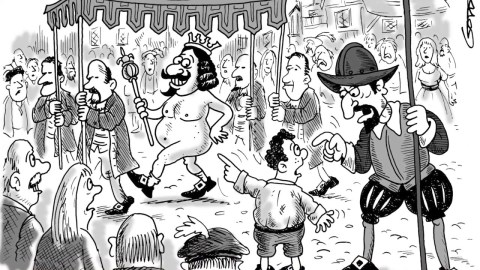
Most of us are likely somewhere between casually or intimately familiar with the Hans Christian Andersen story titled “The Emperor Haas No Clothes“. It’s a popular tale that has an important object lesson, and for this reason it is often employed as a metaphor for gullibility of the people in power, be they Presidents or Prime Ministers or established politicians in general. And for the most part, that interpretation is understandable, while yet, in my humble view, grossly mischaracterised.
The object lesson can certainly stand the test of time; however, the unfortunate mischaracterization begins at the very top: The King. For all intents and purposes, the king in a Democracy is not the elected official in the persona of a President or a Prime Minister or any member of Parliament for that matter. If one would recall the etymology of the word “Democracy” as being found in the Greek word “demoskratia”, it would then be recalled that therein the “demos” part of the word can be translated as “common people”. The latter half of demoskratia hails from the Greek word “kratos” meaning rule. When combined, the word speaks to the rule by the common people. One definition describes democracy as “system of government in which the sovereign power is vested in the people as a whole exercising power directly or by elected officials.” Therefore, the “Emperor” in this timeless tale (at least as far as a democracy is concerned) is the citizenry or the common man and woman. Continue reading
 Res Publica360