
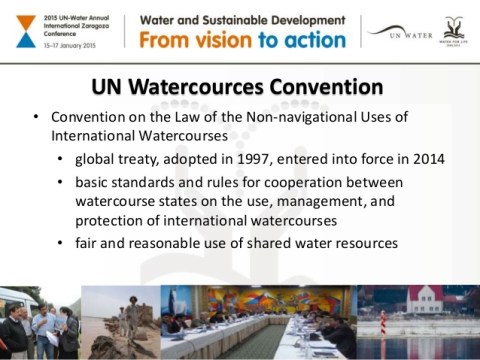
 “Today, the more balanced concept of ‘limited territorial sovereignty’ is widely accepted as the foundation upon which the law of international watercourses in general, and the UNWC in particular, have evolved. It stipulates that all watercourse states enjoy an equal right to the utilisation of a shared water resource, and that each watercourse state has to respect the sovereignty and correlative rights of other watercourse states – i.e. that it must not exceed its own right to equitable utilisation.” — (Theories of Allocation, from UN Watercourses’s Convention User Guide)
In many respects, the quote above is self explanatory, especially if one is even vaguely acquainted with the principles of international customary law that have been enshrined in the United Nations Watercourses Convention (UNWC). But the situation in the Sarstoon River, the international watercourse that forms Belize’s southernmost border with Guatemala, demands that a closer look be given to the principle of limited territorial sovereignty, as enshrined in the UNWC, and to the principle of community of interest.

 Res Publica360